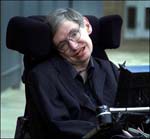
Stephen Hawking Named Lifeboat Foundation 2008 Guardian Award Winner
The 2008 Lifeboat Foundation Guardian Award has been given to Stephen Hawking. This award is in recognition of his continuous warnings that global catastrophic risks will eventually come and therefore it is unsafe and unwise for all of humanity to be on a single planet.
Hawking’s quotes include:
At considerable risk to his frail health, Hawking inspired mankind to live on more than one planet by entering Zero G. You can watch him experience Zero G at https://www.youtube.com/watch?v=kmurxp8m9Dk. Our Nobel Laureate Wole Soyinka will soon be following Hawking’s example.
Hawking does his best to keep the public informed about the dangers to come. Due to warnings by Hawking and others, the Doomsday Clock was moved to five minutes before midnight in 2007.
“It is now five minutes to midnight,” Hawking said after the clock was moved forward two minutes from 11:53 pm, where it had stood since 2002.
“We foresee great peril if governments and scientists don’t take action now to render nuclear weapons obsolete and to prevent further climate change,” he added. The Bulletin of the Atomic Scientists has kept a Doomsday clock since 1947 as a reminder of the dangers of nuclear proliferation.
Stephen Hawking was born on the 300th anniversary of Galileo’s death. He has come to be thought of as the greatest mind in physics since Albert Einstein. With similar interests — discovering the deepest workings of the universe — he has been able to communicate arcane matters not just to other physicists but to the general public.
Hawking grew up outside London in an intellectual family. His father was a physician and specialist in tropical diseases; his mother was active in the Liberal Party. He was an awkward schoolboy, but knew from early on that he wanted to study science. He became increasingly skilled in mathematics and in 1958 he and some friends built a primitive computer that actually worked. In 1959 he won a scholarship to Oxford University, where his intellectual capabilities became more noticeable.
In 1962 he got his degree with honors and went to Cambridge University to pursue a Ph.D. in cosmology. There he became intrigued with black holes (first proposed by Robert Oppenheimer) and “space-time singularities,” or events in which the laws of physics seem to break down. After receiving his Ph.D., he stayed at Cambridge, becoming known even in his 20s for his pioneering ideas and use of Einstein’s formulas, as well as his questioning of older, established physicists.
In 1968 he joined the staff of the Institute of Astronomy in Cambridge and began to apply the laws of thermodynamics to black holes by means of very complicated mathematics. He published the very technical book, Large Scale Structure of Space-Time but soon afterwards made a startling discovery. It had always been thought that nothing could escape a black hole; Hawking suggested that under certain conditions, a black hole could emit subatomic particles. That is now known as Hawking Radiation.
He continued working on the theory of the origin of the universe, and in doing so found ways to link relativity (gravity) with quantum mechanics (the inner workings of atoms). This contributed enormously to what physicists call Grand Unified Theory, a way of explaining, in one equation, all physical matter in the universe.
At the remarkably young age of 32, he was named a fellow of the Royal Society. He received the Albert Einstein Award, the most prestigious in theoretical physics. And in 1979, he was appointed Lucasian Professor of Mathematics at Cambridge, the same post held by Sir Isaac Newton 300 years earlier. There he began to question the big bang theory, which by then most had accepted. Perhaps, he suggested, there was never a start and would be no end, but just change — a constant transition of one “universe” giving way to another through glitches in space-time. All the while, he was digging into exploding black holes, string theory, and the birth of black holes in our own galaxy.
In 1988 Hawking wrote A Brief History of Time: From the Big Bang to Black Holes, explaining the evolution of his thinking about the cosmos for a general audience. It became a best-seller of long standing and established his reputation as an accessible genius. He wrote other popular articles and appeared in movies and television. He remains extremely busy, his work hardly slowed by Lou Gehrig’s disease (amyotrophic lateral sclerosis, a disease that affects muscle control) for which he uses a wheelchair and speaks through a computer and voice synthesizer.
“My goal is simple. It is complete understanding of the universe, why it is as it is and why it exists at all.”