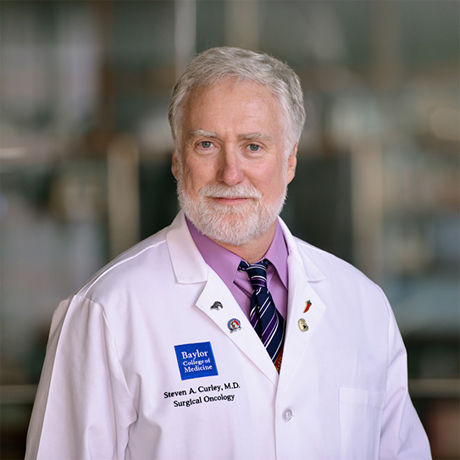
Dr. Steven A. Curley
Steven A. Curley, M.D., F.A.C.S. is Professor and Chief of Surgical Oncology at the Baylor College of Medicine and Professor in Nano-Materials Science at Rice University and at the University of Texas Medical School in Houston, Texas. He is also the Director of the local and regional CHI Oncology Service line at the Baylor St. Luke’s Medical Center, and Associate Director for Clinical Affairs at the NCI-designated Dan L. Duncan Comprehensive Cancer Center at the Baylor College of Medicine.
Steve was a member of the faculty at the University of Texas M. D. Anderson for 22 years, and joined the faculty at the Baylor College of Medicine in January 2014. His clinical duties involve providing surgical care for patients with hepatobiliary and gastrointestinal malignancies. He operates on patients two days a week and has a full clinic every week to evaluate new, consult, and follow-up patients. The remainder of his time is spent on clinical and laboratory research.
His research laboratory has been involved in design, bench testing, preclinical testing, and clinical testing of two devices and one new drug which have all successfully gone through the full FDA approval process. Thus, this is truly a translational research laboratory. The laboratory is currently focused on testing of a novel noninvasive radiofrequency (RF) field treatment device. This is coupled with targeted delivery of metallic or semiconducting nanoparticles to cancer cells which release heat under RF field induction, thus causing thermal cytotoxicity in cancer cells. He is performing complex physicochemical measurements of the nanoparticles, and conjugating the nanoparticles to antibodies, peptides, and pharmacologic agents to target them to cancer cells.
His laboratory combines physics, chemistry, molecular biology, and bioengineering to produce a state-of-the-art approach to novel cancer treatment. Furthermore, he has discovered that many of the nanoparticles are multifunctional and may be used as optical or radiologic diagnostic materials, in addition to being used as therapeutic agents in the noninvasive RF field. He is currently performing in vivo preclinical studies with this RF/nanoparticle system to obtain data adequate to allow his team to petition the FDA for human clinical trials. He will begin with two particularly lethal human cancers, pancreatic ductal adenocarcinoma and hepatocellular carcinoma.
At the Baylor College of Medicine and at CHI Baylor St. Luke’s Hospital, he is committed to developing world class multidisciplinary care programs for patients with all types of cancer. The National Cancer Institute-designated Dan L. Duncan Cancer Center will lead basic, translational, and clinical research efforts to provide cutting edge, personalized cancer care for patients in Houston and surrounding areas.
Steve will collaborate with physicians and care providers throughout his region to provide timely and effective care and service. At CHI Baylor St. Luke’s Hospital (BSLH) he will work collaboratively with all of his physician colleagues and allied health professionals to produce the best outcomes for his cancer patients in a supportive and caring environment. The CHI BSLH Cancer Program is currently being thoroughly evaluated and upgraded to improve patient admission processes, enhance communication and reporting to referring physicians, and to develop optimal programs to assure a leadership status in cancer prevention, diagnosis, treatment, and patient and family care, support, and outcomes.
At the Baylor College of Medicine he provides state-of-the-art cancer care for all patients in his region, working to break down health care disparities based on race and socioeconomic status. He is also initiating global health care initiatives to educate populations and physicians on improving prevention, screening, diagnosis, and treatment of malignant diseases.
Read his LinkedIn profile. Follow his X feed.