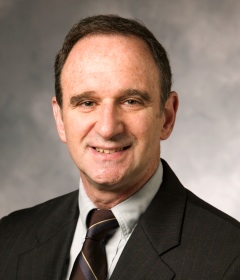
Professor Martin E. Hellman
Martin E. Hellman, PhD, is Professor Emeritus of Electrical Engineering at Stanford University, an Affiliated Faculty Member of Stanford's Center for International Security and Cooperation (CISAC), and Adjunct Senior Fellow for Nuclear Risk Analysis at the Federation of American Scientists.
He is best known for inventing public key cryptography with Whitfield Diffie and Ralph Merkle, the technology that secures e-commerce and financial transactions on the otherwise insecure Internet.
Marty has worked on international security since 1985. His project Defusing the Nuclear Threat applies engineering risk analysis to nuclear deterrence and estimates the risk of nuclear war at roughly one percent per year. Read Risk Analysis of Nuclear Deterrence and Risk Analysis Finds Nuclear Deterrence Wanting.
In How risky is nuclear optimism? (2011), he called on Congress to commission a National Academies risk analysis of nuclear deterrence, and Section 1674 of the FY2020 National Defense Authorization Act mandated such a study. Read his Comments on NRC Study Mandated by Section 1674 of the FY2020 NDAA.
In 2019, he published Rethinking National Security, the paper behind his project of the same name, whose statement is endorsed by a former NSA Director and several Nobel Laureates. With internet pioneer Vinton G. Cerf, he coauthored An existential discussion: What is the probability of nuclear war? in 2021. In June 2023, he published Daniel Ellsberg's message to us, and to future generations, based on an interview he conducted with Pentagon Papers whistleblower Daniel Ellsberg shortly before Ellsberg's death. Watch his 2019 Lindau Nobel Laureate Meeting Heidelberg Lecture, The Technological Imperative for Ethical Evolution.
Since 2021, Marty has served on the Board of Directors of Verified Voting, which promotes the responsible use of technology in elections, after earlier serving on its Board of Advisors. He is also a Board Member of the Daisy Alliance, an Atlanta-based organization working to reduce reliance on nuclear weapons, and a Member of Helena, an institution that runs projects on critical societal problems alongside its members. Read Verified Voting Welcomes Martin Hellman to its Board of Directors.
Between 1968 and 1969, he worked at IBM's Thomas J. Watson Research Center, where he did cryptographic research under Horst Feistel. From 1969 to 1971, he was Assistant Professor at the Massachusetts Institute of Technology. He returned to Stanford University in 1971 and taught there until becoming Professor Emeritus in 1996.
In 1976, Marty and Diffie published New Directions in Cryptography in IEEE Transactions on Information Theory, introducing public key cryptosystems, the Diffie–Hellman key exchange, and digital signatures. The resulting US Patent 4,200,770, Cryptographic Apparatus and Method, names him, Diffie, and Merkle as inventors. He publicly challenged the 56-bit key of the Data Encryption Standard. Read Exhaustive Cryptanalysis of the NBS Data Encryption Standard.
With Stephen Pohlig, he published the Pohlig–Hellman algorithm in An Improved Algorithm for Computing Logarithms over GF(p) and Its Cryptographic Significance (1978), followed by A Cryptanalytic Time-Memory Trade-Off (1980). From 1994 to 1996, he served on the National Research Council's Committee to Study National Cryptography Policy, which produced Cryptography's Role in Securing the Information Society. Merkle completed his PhD under Marty's supervision in 1979.
In the 1980s, he coedited with Soviet scholar Anatoly Gromyko Breakthrough: Emerging New Thinking, published in Russian in 1987 and in English in 1988. With his wife Dorothie, he coauthored A New Map for Relationships: Creating True Love at Home and Peace on the Planet (2016), and the couple devoted his $500,000 share of the Turing Award prize to that work. Read The Turing Award, Nuclear Risk, and Recapturing True Love. At Stanford University, his “no fault” approach to diversity earned three teaching awards from minority student organizations.
With Diffie, Marty received the 2015 ACM A.M. Turing Award ”for critical contributions to modern cryptography,” which carries a $1 million prize. He received the 2000 Marconi Prize and shared the 2010 IEEE Richard W. Hamming Medal with Diffie and Merkle. He was elected to the National Academy of Engineering in 2002 “for contributions to the theory and practice of cryptography,” inducted into the National Inventors Hall of Fame and named a Computer History Museum Fellow in 2011, and inducted into the National Cyber Security Hall of Fame in 2012.
He is an IEEE Fellow (1980), IACR Fellow (2006), and ACM Fellow (2020). Earlier honors include the 1984 IEEE Centennial Medal, the 1994 EFF Pioneer Award, and the 1997 Franklin Institute Levy Medal and ACM Kanellakis Award. Read the full list of his honors.
Marty earned his B.E. in Electrical Engineering in 1966 from New York University, and his MSc in 1967 and PhD in 1969, both in Electrical Engineering, from Stanford University, where his dissertation, Learning with Finite Memory, was supervised by Thomas M. Cover. Between 1966 and 1968, he was a National Science Foundation Graduate Fellow. He is a graduate of the Bronx High School of Science.
Read his Oral history interview with Martin Hellman for the Charles Babbage Institute (2004), his 2011 Computer History Museum interview, and The Ethics of Technology: A Conversation with Prof. Martin E. Hellman. In his spare time, he enjoys soaring.
Read his blog Defusing the Nuclear Threat.
Visit his homepage, LinkedIn profile, Wikipedia page, Stanford Profiles page, and ACM Turing Award page. Follow him on Facebook.