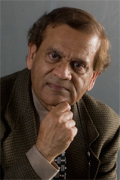
Professor Asim Roy
Asim Roy, Ph.D. is a Professor of Information Systems at Arizona State University. He received his B.E. in Mechanical Engineering from Calcutta University, India, his M.S. in Operations Research from Case Western Reserve University, Cleveland, Ohio, and his Ph.D. in Operations Research from the University of Texas at Austin. He has been a Visiting Scholar at Stanford University, visiting Professor David Rumelhart in the Psychology Department, and a Visiting Scientist at the Oak Ridge National Laboratory, Tennessee. He was an ASU-Mayo Clinic Alliance Fellow in 2017 and developed personalized models for heart failure prediction.
He is the founder of the faculty startup Teuvonet Technologies (www.teuvonet.com). Teuvonet Technologies develops machine learning systems that are embedded in GPUs, FPGAs and other types of hardware platforms. Such embedded systems can learn in real-time from streaming data at the edge of the Internet of Things (IoT) and don’t need to transfer data to the cloud for learning.
Asim has also developed a method to decode a convolutional neural network (CNN) and extract symbolic rules in the form desired by DARPA. (Explainable Artificial Intelligence).
He was on the Governing Board of the International Neural Network Society (INNS) and its VP of Industrial Relations. He is the founder of three INNS Sections, (1) Autonomous Machine Learning (AML Section), (2) Big Data Analytics (Big Data Section), and (3) Explainable AI (XAI Section). He also started the Virtual Technical Event series of INNS.
He was the Guest Editor-in-Chief of an open access eBook Representation in the Brain of Frontiers in Psychology. He was also the Guest Editor-in-Chief of two special issues of Neural Networks — one on autonomous learning and the other on big data analytics. He is currently the Guest Editor-in-Chief of the special issue of Cognitive Computation on “What AI and Neuroscience can learn from each other.” He is the Senior Editor of the Big Data Analytics section of Cognitive Computation, and serves on the editorial boards of Neural Networks and Cognitive Computation.
He has served on the organizing committees of many scientific conferences. He started the Big Data conference series of INNS and was the General Co-Chair of the first one in San Francisco in 2015. He was the Technical Program Co-Chair of IJCNN 2015 (International Joint Conference on Neural Networks) in Ireland and the IJCNN Technical Program Co-Chair for the World Congress on Computational Intelligence 2018 (WCCI 2018) in Rio de Janeiro, Brazil. He was the IJCNN Conference Chair for WCCI 2020 in Glasgow, UK (WCCI 2020). He was the Program Chair for the ORSA/TIMS (Operations Research Society of America / The Institute of Management Sciences) National meeting in Las Vegas in 1990 and General Chair of the ORSA/TIMS National meeting in Phoenix in 1993. He has been listed in Who’s Who in America.
His research interests are in theories of the brain, brain-like learning, artificial neural networks, automated machine learning, Explainable AI, hardware-based learning and nonlinear multiple objective optimization. His research has been published in Management Science, Decision Sciences, Mathematical Programming, Neural Networks, Neural Computation, Naval Research Logistics, INFORMS Journal on Computing, IEEE Transactions on Neural Networks, IEEE Transactions on Fuzzy Systems, IEEE Transactions on Systems, Man and Cybernetics, Frontiers in Cognitive Science, Frontiers in Neuroscience and other journals.
Designed and developed IFPS/OPTIMUM
Asim designed and developed the software system IFPS/OPTIMUM that pioneered the
idea of incorporating optimization tools in financial and planning languages
for managerial use. It has been used by hundreds of corporations worldwide for
financial, corporate, and production planning. The system has saved many
companies hundreds of millions of dollars. Following in its footsteps, such
optimization systems are now widely available with spreadsheet systems such as
Excel Solver within Excel.
Asim’s brain theories
Asim has published four theories of the brain. The
first theory postulates that localist representation, as opposed to distributed
representation, is used widely in the brain: A
theory of the brain: localist representation is used widely in the brain.
That implies that firings of neurons in the brain have “meaning and
interpretation” on a stand-alone basis. The second theory postulates that
grandmother cells are used widely in the brain: An
extension of the localist representation theory: grandmother cells are also
widely used in the brain. Grandmother cells are a special type of localist
cells and represent complex concepts that are multimodal invariant. The third
theory postulates that a purely abstract cognitive
system exists in the brain at different levels of processing: The Theory of
Localist Representation and of a Purely Abstract Cognitive System: The Evidence
from Cortical Columns, Category Cells, and Multisensory Neurons.
In 2008, Asim published a theory of
the brain that postulates that there are parts of the brain that control other
parts and thus control theoretic principles that can be used to design and construct
systems like the brain: Connectionism, controllers and a brain theory.
These four theories invalidate many ideas of the current dominant theory of the
brain called “Connectionism”.
Phys.org reported on Asim’s brain theories
Phys.org did the following reports on Asim’s
brain theories:
- On grandmother cells: If you can’t beat them, join them: Grandmother cells revisited
- On localist representation: Do brain cells need to be connected to have meaning?
- On the controller theory of the brain: Professor Finally Publishes Controversial Brain Theory
Here’s the response to the criticism of the localist representation theory by James McClelland of Stanford University and David Plaut of Carnegie Mellon University: Response to Plaut and McClelland in the Phys.org story.
Asim’s work has been described as pioneering by distinguished scholars in the field. He has been invited to many national and international conferences for plenary and keynote talks and for tutorials, workshops and short courses on his new learning theory and methods.
Read his LinkedIn profile.