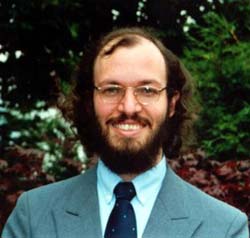
Dr. Adriano Cavalcanti
The PhysOrg article Virtual 3D nanorobots could lead to real cancer-fighting technology said
“Adriano Cavalcanti, Bijan Shirinzadeh, Robert Freitas, Jr., and Tad Hogg, representing institutions in Melbourne, Australia, and the U.S., have published their simulation procedure in a recent issue of Nanotechnology. Just as 3D simulations previously helped engineers greatly accelerate developmental research in the semiconductor industry, Cavalcanti and colleagues hope that virtual nanorobots, virtual biomolecules and virtual arteries will accelerate the progress of nanorobot development.‘The software NCD (nanorobot control design) is a system implemented to serve as a test bed for nanorobot 3D prototyping,’ Cavalcanti, CEO of the Center for Automation in Nanobiotech and researcher at Monash University in Melbourne, told PhysOrg.com. ‘It is an advanced nanomechatronics simulator that provides physical and numerical information for nanorobot task-based modeling. Serving as a fast development platform for medical nanorobots investigation, the NCD simulations show how to interact and control a nanorobot inside the body.’
‘One of the major factors for successfully developing nanorobots is to bring together professionals with interdisciplinary views of science and technologies,’ Cavalcanti said. ‘It is necessary to keep your eyes open for chemistry, materials engineering, electronics, computing, physics, mechanics, photonics, pharmaceutics, and medicine technologies. Our work is advancing progressively because we have experts from different backgrounds participating. We all pursue a common interest in working together to build medical nanorobots.’”
Adriano Cavalcanti, Ph.D. is Chairman and CEO of CAN Center for Automation in Nanobiotech. Its key development areas are biosensor, nanobioelectronics, and nanorobotics for in vivo nanomedicine application in diabetes, cancer, cardiology, and brain aneurysm. It is focused on the implementation of new technologies for innovative integrated system design. The equipment prototyping at CAN should enable new instrumentation for in vivo diagnosis, drug delivery and surgery. Their business project is to provide new effective medical devices through the development of commercial nanobiotechnology.
Adriano authored Nanorobot Invention and Linux: The Open Technology Factor: An Open Letter to the UNO General Secretary, and coauthored Hardware Architecture for Nanorobot Application in Cancer Therapy, Nanorobots for Laparoscopic Cancer Surgery, Medical Nanorobot Architecture Based on Nanobioelectronics, CMOS-based Nanorobot to Combat Cancer, Nanorobot Communication Techniques: A Comprehensive Tutorial, Hardware Architecture for Nanorobot Application in Cerebral Aneurysm, Nanorobot for Treatment of Patients with Artery Occlusion, Computational Nanomechatronics: A Pathway for Control and Manufacturing Nanorobots, and Nanorobotics Control Design: A Practical Approach Tutorial. Read the full list of his publications!
He has been developing several research projects related to autonomous systems, equipment prototyping, and physically based simulation. Among other projects, he is working through the publication of two new books in Nanorobotics, and is preparing to commercialize the software Nanorobot Control Design (NCD) as a valuable tool for Nanotechnologists, Engineers, and Machine Designers.
Adriano earned a B.S. in Computer Science from Sao Paulo State University, a M.S. in Electrical Engineering focusing on automation and control from State University of Campinas, Brazil, and a Ph.D. in Mechanical Engineering from Monash University, Australia.
Read Adriano Cavalcanti on Medical Nanorobotics Feasibility, Nanorobot for drug delivery and diagnosis, Medical nanorobotics for diabetes, Nanorobot pioneer reveals status of simulator, stem cell work, Nanorobots to improve health care, and Nanorobot Hardware Architecture for Medical Defense.