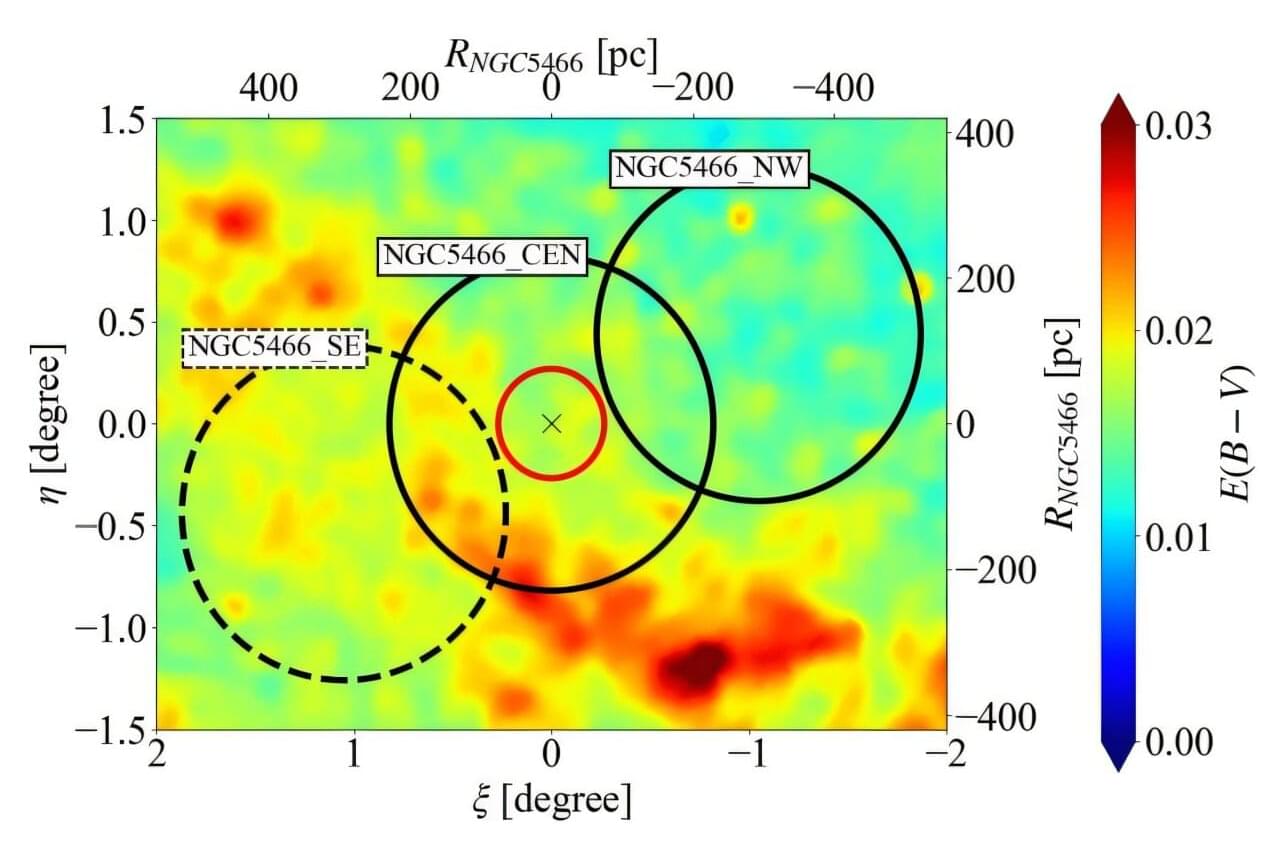
Astronomers from the National Astronomical Observatory of Japan (NAOJ) and elsewhere have used the Subaru Telescope to perform deep imaging observations of a distant globular cluster known as NGC 5466. The observational campaign yields important information about the structure of the cluster’s tidal stream. The new findings were published February 4 on the arXiv preprint server.
In general, stellar tidal streams are the result of tidal interactions between a central galaxy and lower mass systems such as satellite galaxies or globular clusters (GCs). Therefore, they could keep the memory of their progenitors’ chemical and dynamical information, even after a few billion years.