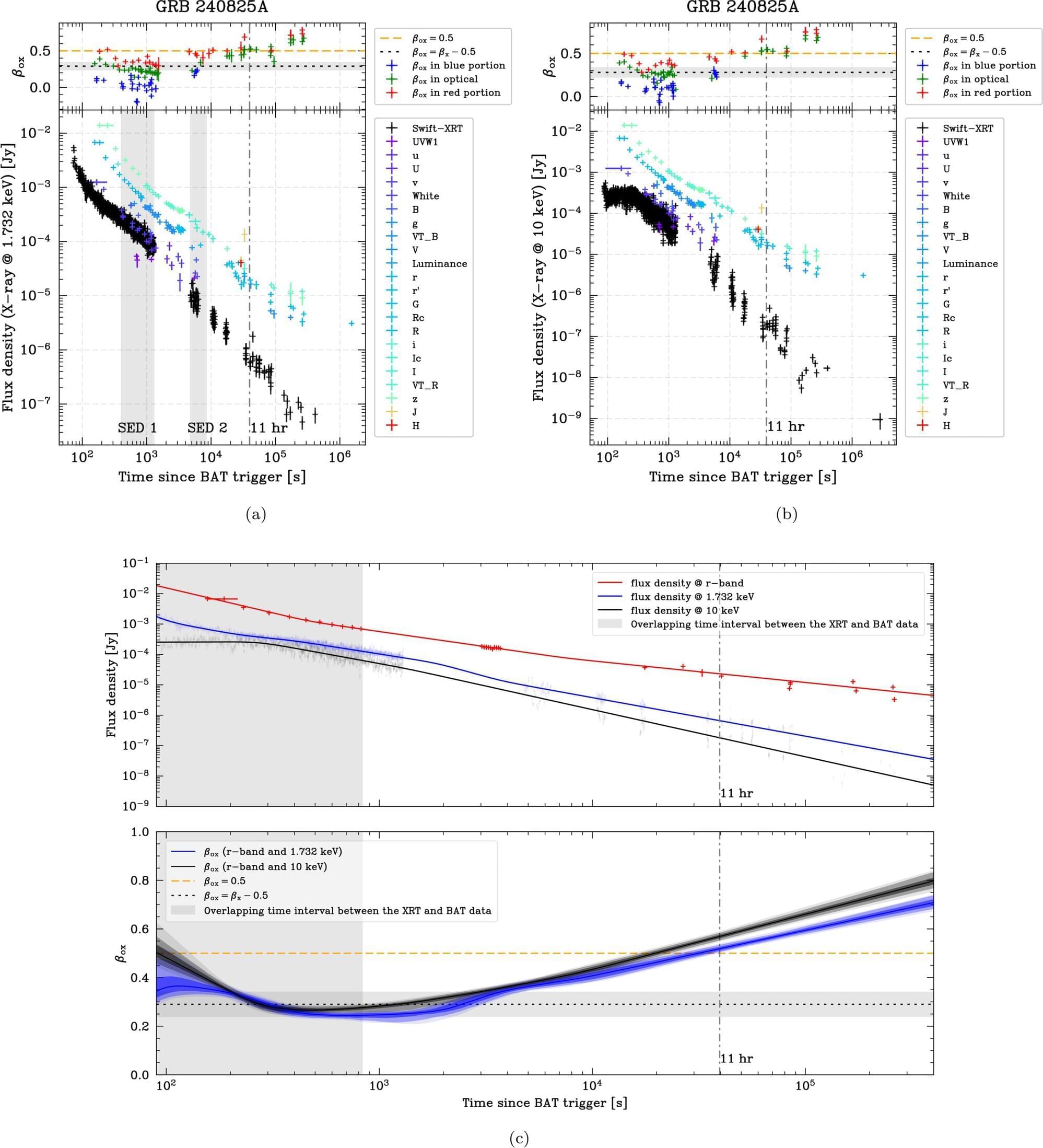
Researchers from the Yunnan Observatories of the Chinese Academy of Sciences have conducted a new study on the temporal evolution of the afterglow from gamma-ray burst GRB 240825A. The study offers new evidence to better understand the physical environment surrounding gamma-ray bursts and provides insights into the mechanisms that govern their afterglow emission. The findings were recently published in The Astrophysical Journal.
Long-duration gamma-ray bursts (LGRBs) are widely believed to form from the core collapse of massive stars, usually occurring in dense star-forming regions. NASA’s Swift satellite detected GRB 240825A on August 25, 2024, and observed an unusually bright optical counterpart.
Early measurements yielded an X-ray afterglow spectral index of 0.79 and a significantly softer optical afterglow spectral index of 2.48, compared with a typical value near 1. Under standard models, a gamma-ray burst is classified as “optically dark” when its observed optical afterglow flux falls below the level predicted from its X-ray spectral index.