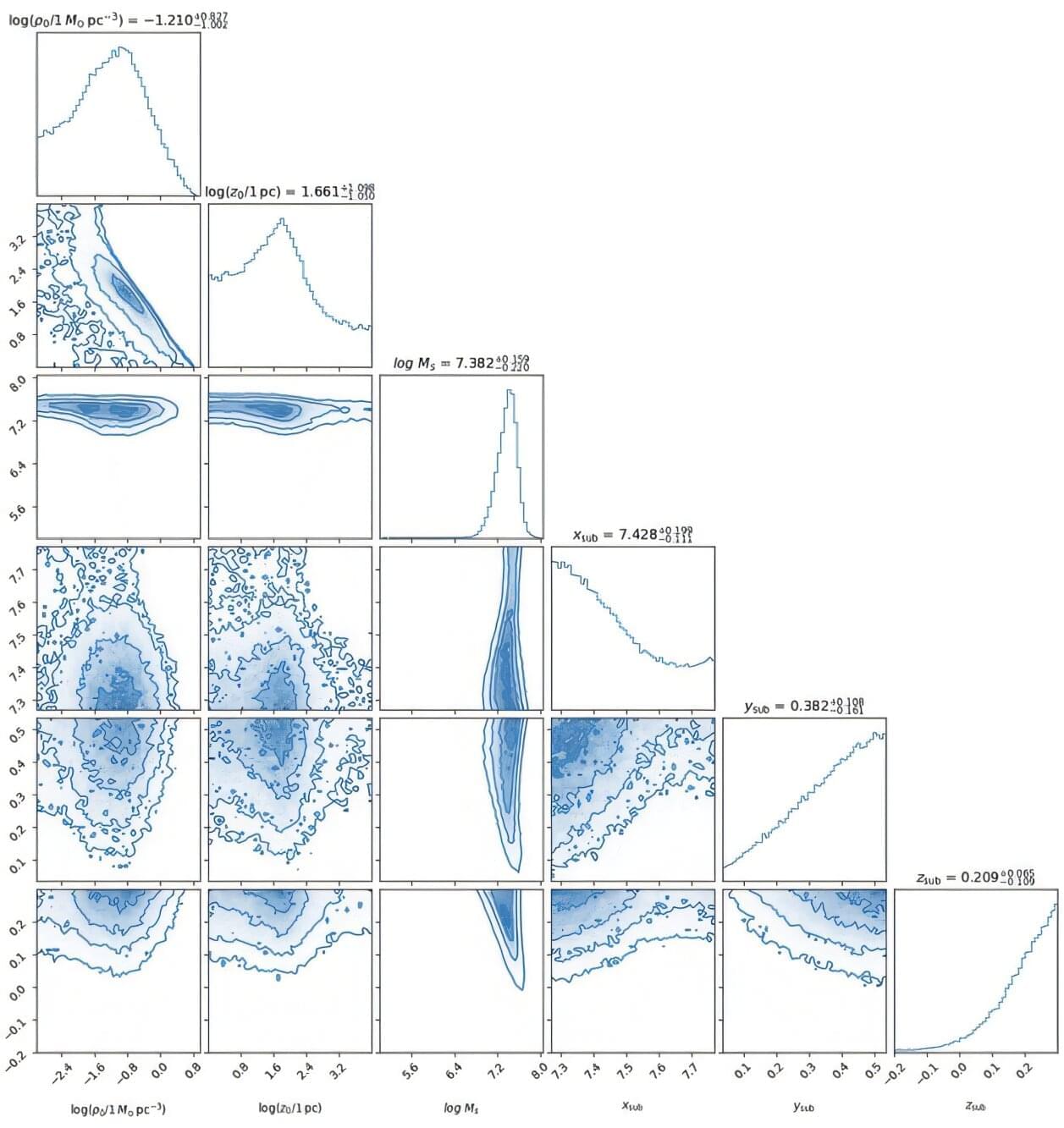
A group of US astronomers may have uncovered the first evidence for a dark matter sub-halo lurking just beyond our stellar neighborhood. Reporting their findings in Physical Review Letters, a team led by Sukanya Chakrabarti at the University of Alabama in Huntsville suggests that an unseen clump of dark matter could be subtly tugging on nearby pulsars. If confirmed, the result could shed new light on the elusive nature of dark matter and how it is distributed throughout our galaxy.
Despite never having been observed directly, astronomers estimate that dark matter makes up around 85% of the total mass of the universe. According to the best available cosmological models, this invisible material forms vast, diffuse “halos” that completely envelop the flat disks of galaxies like the Milky Way. These halos, in turn, should be populated by numerous smaller structures known as dark matter sub-halos.
If theoretical predictions are correct, such sub-halos should be abundant throughout the galaxy. Yet even with masses potentially exceeding tens of millions of times that of the sun, their limited gravitational influence on visible matter has so far made them extraordinarily difficult to detect.