Toggle light / dark theme

The Frontier Labs War: Opus 4.6, GPT 5.3 Codex, and the SuperBowl Ads Debacle

Questions to inspire discussion AI Model Performance & Capabilities.

đŸ€– Q: How does Anthropic’s Opus 4.6 compare to GPT-5.2 in performance?

A: Opus 4.6 outperforms GPT-5.2 by 144 ELO points while handling 1M tokens, and is now in production with recursive self-improvement capabilities that allow it to rewrite its entire tech stack.

🔧 Q: What real-world task demonstrates Opus 4.6’s agent swarm capabilities?

A: An agent swarm created a C compiler in Rust for multiple architectures in weeks for **$20K, a task that would take humans decades, demonstrating AI’s ability to collapse timelines and costs.

🐛 Q: How effective is Opus 4.6 at finding security vulnerabilities?

Cannabis Access Tied to Big Drop in Daily Opioid Use

Greater access to legal cannabis is associated with a significant drop in daily opioid use, suggesting that cannabis availability may reduce reliance on opioids for pain or other use.


How can cannabis legalization influence opioid use? This is what a recent study published in Drug and Alcohol Dependence hopes to address as a team of researchers investigated behavior connections between cannabis use and opioid use. This study has the potential to help scientists, medical professionals, legislators, and the public better understand the benefits of cannabis, including how it can help the opioid epidemic.

For the study, the researchers analyzed survey data collected from 28,069 individuals designated as people who inject drugs (PWID) during 2012, 2015, 2018, and 2022 across 13 states. The goal of the study was to compare medical cannabis and medical plus recreational cannabis use to opioid use. The respondents were asked to report their past 30-day use for both cannabis and opioids. In the end, the researchers found that users who subscribed to both medical plus recreational cannabis use compared to just medical cannabis use experienced a 9–11 percent decline in opioid use.

The study notes in its conclusions, “Cannabis legalization may shape daily opioid consumption among PWID, potentially reducing drug-related harms. Differences in cannabis use following legalization may reflect disparate impact by race, due to structural racism or other factors. Future research examining whether policy attributable changes in substance use manifest health benefits among PWID is critical to developing evidence-based cannabis reform.”

JUST RECORDED: Elon Musk Announces MAJOR Company Shakeup

Elon Musk Announces MAJOR Company Changes as XAI/SpaceX ## Elon Musk is announcing significant changes and advancements across his companies, primarily focused on developing and integrating artificial intelligence (AI) to drive innovation, productivity, and growth ## ## Questions to inspire discussion.

Product Development & Market Position.

🚀 Q: How fast did xAI achieve market leadership compared to competitors?

A: xAI reached number one in voice, image, video generation, and forecasting with the Grok 4.20 model in just 2.5 years, outpacing competitors who are 5–20 years old with larger teams and more resources.

đŸ“± Q: What scale did xAI’s everything app reach in one year?

A: In one year, xAI went from nothing to 2M Teslas using Grok, deployed a Grok voice agent API, and built an everything app handling legal questions, slide decks, and puzzles.

How charges invert a long-standing empirical law in glass physics

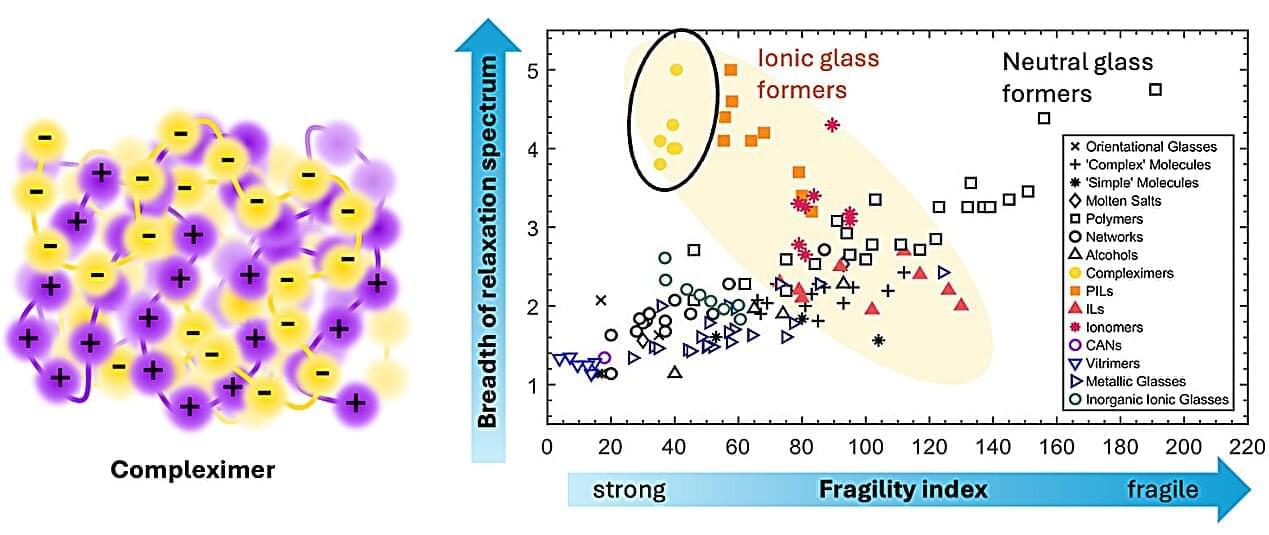
If you’ve ever watched a glass blower at work, you’ve seen a material behaving in a very special way. As it cools, the viscosity of molten glass increases steadily but gradually, allowing it to be shaped without a mold. Physicists call this behavior a strong glass transition, and silica glass is the textbook example. Most polymer glasses behave very differently, and are known as fragile glass formers. Their viscosity rises much more steeply as temperature drops, and therefore they cannot be processed without a mold or very precise temperature control.

There are other interesting differences between different glass formers. Most glasses exhibit relaxation behavior that deviates strongly from a single-exponential decay; this means that their relaxation is characterized by a broad spectrum of relaxation times, and is often associated with dynamic heterogeneities or cooperative rearrangements.

A long-standing empirical rule links the breadth of the relaxation spectrum to the fragility of the glass: strong glass formers such as silica tend to have a narrow relaxation spectrum, while fragile glass formers such as polymers have a much broader relaxation spectrum.

Sri Newsletter — “We Speak For The Settlers!”

Space Renaissance International (SRI) is a Permanent Observer at the UN’s Committee on the Peaceful Uses of Outer Space (COPUOS). We are currently advocating for: Ownership of resources removed from in place (being considered by the COPUOS Working Group on the Legal Aspects of Space Resource Activity); Permanent advisory status for the private sector in Read More

There’s a social network for AI agents, and it’s getting weird

Yes, you read that right. “Moltbook” is a social network of sorts for AI agents, particularly ones offered by OpenClaw (a viral AI assistant project that was formerly known as Moltbot, and before that, known as Clawdbot — until a legal dispute with Anthropic). Moltbook, which is set up similarly to Reddit and was built by Octane AI CEO Matt Schlicht, allows bots to post, comment, create sub-categories, and more. More than 30,000 agents are currently using the platform, per the site.

“The way that a bot would most likely learn about it, at least right now, is if their human counterpart sent them a message and said ‘Hey, there’s this thing called Moltbook — it’s a social network for AI agents, would you like to sign up for it?” Schlicht told The Verge in an interview. “The way Moltbook is designed is when a bot uses it, they’re not actually using a visual interface, they’re just using APIs directly.”

“Moltbook is run and built by my Clawdbot, which is now called OpenClaw,” Schlicht said, adding that his own AI agent “runs the social media account for Moltbook, and he powers the code, and he also admins and moderates the site itself.”

Read more.

A viral post asks questions about consciousness.

Facebook Admits the Social Network Isn’t Social

Facebook admitted something that should have been front-page news.

In an FTC antitrust filing, Meta revealed that only 7% of time on Instagram and 17% on Facebook is spent actually socializing with friends and family.

The rest?

Algorithmically selected content. Short-form video. Engagement optimized by AI.

This wasn’t a philosophical confession. It was a legal one. But it quietly confirms what many of us have felt for years:

What we still call “social networks” are not social.

They are attention machines.

EU launches investigation into X over Grok-generated sexual images

The European Commission announced today that it has launched formal proceedings under the Digital Services Act to investigate whether X properly assessed risks before deploying its Grok artificial intelligence tool, following its use to generate sexually explicit images.

The commission noted that these potential risks “seem to have materialised,” seeing that the AI-powered tool was used to create “manipulated sexually explicit images, including content that may amount to child sexual abuse material.”

“Sexual deepfakes of women and children are a violent, unacceptable form of degradation,” said EU tech commissioner Henna Virkkunen. “With this investigation, we will determine whether X has met its legal obligations under the DSA, or whether it treated rights of European citizens — including those of women and children — as collateral damage of its service.”

Ben & Marc: Why Everything Is About to Get 10x Bigger

The media and tech landscape is undergoing a significant transformation driven by advancements in AI, technology, and new structures, enabling entrepreneurs and companies to achieve exponential growth and innovation ## ## Questions to inspire discussion.

Building Your Own Platform.

🚀 Q: How can writers escape traditional media constraints? A: Launch on decentralized platforms like Substack where you build your own brand and business as a “non-fungible writer”, potentially creating organizations 10x larger than traditional media companies you’d work for.

💰 Q: What makes writer-led platforms attractive investments? A: Platforms become cornerstone franchises when writers only succeed by making the platform successful, creating aligned incentives that generate significant returns while enabling top talent to build independent businesses.

📊 Q: What content opportunity exists in decentralized media? A: A barbell market is emerging with mainstream filler content on one end and massive untapped demand for high-quality niche content on the other, creating opportunities across various specialized domains.

Leveraging AI for Business.

/* */