Toggle light / dark theme

Early vertebrate biomineralization and eye structure determined by synchrotron X-ray analyses of Silurian jawless fish

Complex eyes in vertebrates may have evolved as early as 500 million years ago. Reconstructing the early evolutionary history of vertebrates requires understanding organisms that existed before bone evolved. However, these ‘soft-bodied’ fossils are inherently difficult to study, resulting in conflicting anatomical and evolutionary interpretations. For the first time, researchers used synchrotron-based imaging techniques to examine two Silurian taxa, Jamoytius and Lasanius, that may bridge the gap between the bone-less and boned vertebrates. They recover the first direct evidence of biomineralised apatitic bone in both taxa and of camera-eyes in Jamoytius. The discoveries indicate vertebrate bones and complex eyes evolved earlier than previously thought, and demonstrate the power of these techniques for problematic fossils.

Read the article in Proceedings B.


Abstract. Understanding the origin and early diversification of vertebrates has always been a challenge because of the ambiguous and conflicting interpretations of the soft-bodied, pre-biomineralization fossil record. Here, we apply synchrotron radiation techniques to Jamoytius and Lasanius, two soft-bodied Silurian vertebrates, key taxa for discerning vertebrate bone evolution owing to highly localized, but debated, biomineralization. We map soft-tissue structures and quantify details of biochemical residue impossible to resolve with traditional methods. We present the first unequivocal evidence for biomineralized apatitic scales in Jamoytius by combining synchrotron rapid scanning X-ray fluorescence and Fourier transform infrared spectroscopy (elevated Ca 37% and P 21%). This approach also recovers robust evidence for apatitic biomineralization in Lasanius. Chemical mapping of the optical anatomy of Jamoytius recovers a close correlation with Zn and Cu distribution, providing evidence for a retinal pigmented epithelium and complex eyes. In both taxa, chemical maps reveal original anatomical details not apparent in visible light, including potential evidence of other sensory anatomy in Jamoytius. Our work resolves long-standing fundamental anatomical debates, indicating stem-group origins for bone and complex eyes in vertebrates. We highlight the potential of using a powerful combination of analytical techniques to unlock otherwise inaccessible data in problematic fossils.

A prebiotic template-directed peptide synthesis based on amyloids

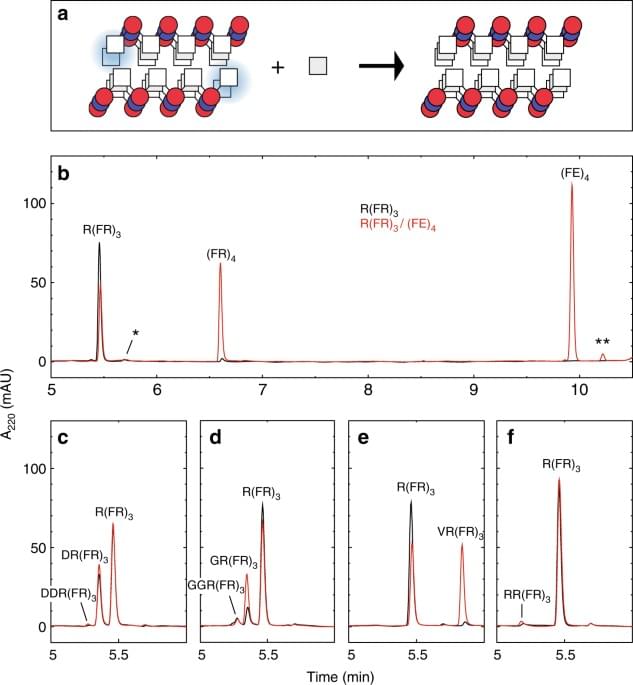
Amyloids may have played an important role in prebiotic molecular evolution but understanding replication of such information-coding molecules is still a problem. Here the authors design a model amyloid substrate and demonstrate sequence regio- and stereoselectivity during template-based replication.

Gravitational lensing technique unveils supermassive black hole pairs

Supermassive black hole binaries form naturally when galaxies merge, but scientists have only confidently observed a very few of these systems that are widely separated. Black hole binaries that closely orbit each other have not yet been measured. In a paper published today in Physical Review Letters, the researchers suggest hunting down the hidden systems by searching for repeating flashes of light from individual stars lying behind the black holes as they are temporarily magnified by gravitational lensing as the binary orbits.

Supermassive black holes reside at the centers of most galaxies. When two galaxies collide and merge, their central black holes eventually form a bound pair, known as a supermassive black hole binary. These systems play a crucial role in galaxy evolution and are among the most powerful sources of gravitational waves in the universe. While future space-based gravitational-wave observatories like LISA will be able to probe such binaries directly, researchers are now showing that they may already be detectable using existing and upcoming electromagnetic surveys.

Activated CD38+ mast cells promote gastric cancer progression by suppressing CD8+ T cell cytotoxic activity through adenosine metabolism

Zhao et al. delineate the dynamic evolution of the gastric mucosal microenvironment and characterize diverse immune cell populations during gastric cancer progression under H. pylori infection. They identify and validate that H. pylori-associated activated mast cells promote gastric cancer through PGE2-and adenosine-mediated suppression of CD8+ T cell cytotoxicity.

Temporal evolution of GRB 240825A afterglow provides insight into origins of optically dark gamma-ray bursts

Researchers from the Yunnan Observatories of the Chinese Academy of Sciences have conducted a new study on the temporal evolution of the afterglow from gamma-ray burst GRB 240825A. The study offers new evidence to better understand the physical environment surrounding gamma-ray bursts and provides insights into the mechanisms that govern their afterglow emission. The findings were recently published in The Astrophysical Journal.

Long-duration gamma-ray bursts (LGRBs) are widely believed to form from the core collapse of massive stars, usually occurring in dense star-forming regions. NASA’s Swift satellite detected GRB 240825A on August 25, 2024, and observed an unusually bright optical counterpart.

Early measurements yielded an X-ray afterglow spectral index of 0.79 and a significantly softer optical afterglow spectral index of 2.48, compared with a typical value near 1. Under standard models, a gamma-ray burst is classified as “optically dark” when its observed optical afterglow flux falls below the level predicted from its X-ray spectral index.

Bennu asteroid reveals new origins for life’s amino acids

“Our results flip the script on how we have typically thought amino acids formed in asteroids,” said Dr. Allison Baczynski.


Did the ingredients for life as we know it exist in the early solar system? This is what a recent study published in the Proceedings of the National Academy of Sciences hopes to address as a team of researchers investigated new evidence for how amino acids, the known building blocks of life, ended up in the asteroid Bennu, which is estimated to have formed during the early days of the solar system billions of years ago. This study has the potential to help scientists better understand the early solar system, how life might have formed on Earth, and potentially elsewhere.

For the study, the researchers analyzed samples of asteroid Bennu that were retrieved and returned to Earth by NASA’s OSIRIS-REx mission in September 2023. The goal of the study was to ascertain the origins of the amino acids that had previously been identified in Bennu samples, which could help scientists gain insights into the origins of life in the early solar system. To accomplish this, the researchers used novel methods for measuring the amount of amino acids while comparing these findings to the carbonaceous meteorite Murchison.

In the end, the researchers discovered that glycine, one of the simplest amino acid molecules, with Bennu was formed in early ices in the early solar system while the glycine found in Murchison was formed in a protoplanetary body, which formed later in the history of the solar system. Additionally, the researchers found that certain aspects of the protein-building amino acid, glutamic acid, found in the Bennu samples, experienced significant changes during its formation and evolution.

A giant tortoise, extinct for over a century, has reappeared alive after several failed expeditions, reviving a historic plan to save the species, a symbol of evolution

Genetic sleuthing has now confirmed that she belongs to the Fernandina Island Galápagos giant tortoise, Chelonoidis phantasticus, a lineage thought lost since a lone male was collected in 1906.

Only two individuals of this lineage have ever been found, the museum specimen from the early twentieth century and Fernanda. To make sure she was not a stray tortoise washed in from another island, researchers sequenced her entire genome and compared it with DNA extracted from the century-old male and from all other living Galápagos tortoise species.

The analyses showed that Fernanda and the museum male form their own distinct branch, separate from the rest of the archipelago’s giants.

The Philosophy of Entropy: Order, Decay, and the Meaning of Equilibrium

Entropy is one of the most profound and misunderstood concepts in modern science — at once a physical quantity, a measure of uncertainty, and a metaphor for the passage of time itself. Entropy: The Order of Disorder explores this concept in its full philosophical and scientific depth, tracing its evolution from the thermodynamics of Clausius and Boltzmann to the cosmology of the expanding universe, the information theory of Shannon, and the paradoxes of quantum mechanics.

At the heart of this study lies a critical insight: entropy in its ideal form can exist only in a perfectly closed and isolated system — a condition that is impossible to realize, even for the universe itself. From this impossibility arises the central tension of modern thought: the laws that describe equilibrium govern a world that never rests.

Bridging physics, philosophy, and cosmology, this book examines entropy as a universal principle of transformation rather than decay. It situates the second law of thermodynamics within a broader intellectual landscape, connecting it to the philosophies of Heraclitus, Kant, Hegel, and Whitehead, and to contemporary discussions of information, complexity, and emergence.

Cancer Vaccines Improve Personalized Medical Care

The concept of cancer vaccines has developed over the last century with initial promise from a young doctor, William Coley. In the late 19th to early 20th century Dr. Coley developed a treatment that elicited strong immune response. This elixir was referred to as Coley’s toxin, which comprised of bacteria that generated an inflammatory response in patients. As a result, the generated response recognized and targeted the patient’s tumor. However, his treatment did not yield consistent clinical benefit. He also had his critics among physicians. At the time, the scientific community debated how safe the toxin was and whether it really worked. Colleagues at Memorial Sloan Kettering and other top institutions questioned Coley’s motive for the toxin, since there was little empirical data or scientific basis for its use. Although Coley’s toxin proved to be an inconsistent treatment, it laid the foundation for future immunotherapies as preventative and therapeutic cancer vaccines were developed.

Cancer vaccines were limited in their ability to effectively treat patients with cancer. Preventative cancer vaccines are difficult to developed because of the uncertainty to predict the onset of mutations in patients. Currently, the only U.S. Food and Drug Administration (FDA) approved preventative cancer vaccine is for the Human Papillomavirus (HPV) vaccine. While it directly protects against HPV, the vaccine indirectly prevents a multitude of cancers, including cervical, anal, and genital. Additionally, researchers have previously struggled to generate a therapeutic vaccine that elicits a strong immune response with limited adverse effects. However, a reinvigorated interest has emerged in therapeutic vaccines due to improved delivery platforms and better biomarkers to target on cancer.

Recently, an article in Cell Reports Medicine, by Dr. Nina Bhardwaj and others, examined the evolution of cancer vaccines. Specifically, the paper focused on tumor biomarker-based vaccines, which are highly personalized and designed to target genetic mutations specific to a patient’s tumor. Bhardwaj is a physician scientist, the Ward-Coleman Chair in Cancer Research, and Director of Vaccine and Cell Therapy Laboratory at the Icahn School of Medicine at Mount Sinai. Her work focuses on improving vaccine strategies to provide strong single agent affect against tumors. Bhardwaj’s group studies different cellular pathways to understand how to therapeutically target cancer.

/* */