A new commercial mobile spyware platform dubbed ZeroDayRAT is being advertised to cybercriminals on Telegram as a tool that provides full remote control over compromised Android and iOS devices.
The malware provides buyers with a full-featured panel for managing infected devices, reportedly supporting Android 5 through 16 and iOS up to version 26 latest.
Researchers at mobile threat hunting company iVerify say that ZeroDayRAT not just steals data but also enables real-time surveillance and financial theft.
A newly documented Linux botnet named SSHStalker is using the IRC (Internet Relay Chat) communication protocol for command-and-control (C2) operations.
The protocol was invented in 1988, and its adoption peaked during the 1990s, becoming the main text-based instant messaging solution for group and private communication.
Technical communities still appreciate it for its implementation simplicity, interoperability, low bandwidth requirements, and no need for a GUI.
A fake 7-Zip website is distributing a trojanized installer of the popular archiving tool that turns the user’s computer into a residential proxy node.
Residential proxy networks use home user devices to route traffic with the goal of evading blocks and performing various malicious activities such as credential stuffing, phishing, and malware distribution.
The new campaign became better known after a user reported that they downloaded a malicious installer from a website impersonating the 7-Zip project while following instructions in a YouTube tutorial on building a PC system. BleepingComputer can confirm that the malicious website, 7zip[.]com, is still live.
SmarterTools confirmed last week that the Warlock ransomware gang breached its network after compromising an email system, but it did not impact business applications or account data.
The company’s Chief Commercial Officer, Derek Curtis, says that the intrusion occurred on January 29, via a single SmarterMail virtual machine (VM) set up by an employee.
“Prior to the breach, we had approximately 30 servers/VMs with SmarterMail installed throughout our network,” Curtis explained.
Microsoft is investigating an ongoing Exchange Online issue that mistakenly flags legitimate emails as phishing and quarantines them.
The incident began on February 5 and continues to affect Exchange Online customers, preventing them from sending or receiving emails.
“Some users’ legitimate email messages are being marked as phish and quarantined in Exchange Online,” Microsoft said in a service alert when it acknowledged the bug on Thursday.
Are we chasing the wrong goal with Artificial General Intelligence, and missing the breakthroughs that matter now?
On this episode of Digital Disruption, we’re joined by former research director at Google and AI legend, Peter Norvig.
Peter is an American computer scientist and a Distinguished Education Fellow at the Stanford Institute for Human-Centered Artificial Intelligence (HAI). He is also a researcher at Google, where he previously served as Director of Research and led the company’s core search algorithms group. Before joining Google, Norvig headed NASA Ames Research Center’s Computational Sciences Division, where he served as NASA’s senior computer scientist and received the NASA Exceptional Achievement Award in 2001.He is best known as the co-author, alongside Stuart J. Russell, of Artificial Intelligence: A Modern Approach — the world’s most widely used textbook in the field of artificial intelligence.
Peter sits down with Geoff to separate facts from fiction about where AI is really headed. He explains why the hype around Artificial General Intelligence (AGI) misses the point, how today’s models are already “general,” and what truly matters most: making AI safer, more reliable, and human-centered. He discusses the rapid evolution of generative models, the risks of misinformation, AI safety, open-source regulation, and the balance between democratizing AI and containing powerful systems. This conversation explores the impact of AI on jobs, education, cybersecurity, and global inequality, and how organizations can adapt, not by chasing hype, but by aligning AI to business and societal goals. If you want to understand where AI actually stands, beyond the headlines, this is the conversation you need to hear.
In this episode: 00:00 Intro. 01:00 How AI evolved since Artificial Intelligence: A Modern Approach. 03:00 Is AGI already here? Norvig’s take on general intelligence. 06:00 The surprising progress in large language models. 08:00 Evolution vs. revolution. 10:00 Making AI safer and more reliable. 12:00 Lessons from social media and unintended consequences. 15:00 The real AI risks: misinformation and misuse. 18:00 Inside Stanford’s Human-Centered AI Institute. 20:00 Regulation, policy, and the role of government. 22:00 Why AI may need an Underwriters Laboratory moment. 24:00 Will there be one “winner” in the AI race? 26:00 The open-source dilemma: freedom vs. safety. 28:00 Can AI improve cybersecurity more than it harms it? 30:00 “Teach Yourself Programming in 10 Years” in the AI age. 33:00 The speed paradox: learning vs. automation. 36:00 How AI might (finally) change productivity. 38:00 Global economics, China, and leapfrog technologies. 42:00 The job market: faster disruption and inequality. 45:00 The social safety net and future of full-time work. 48:00 Winners, losers, and redistributing value in the AI era. 50:00 How CEOs should really approach AI strategy. 52:00 Why hiring a “PhD in AI” isn’t the answer. 54:00 The democratization of AI for small businesses. 56:00 The future of IT and enterprise functions. 57:00 Advice for staying relevant as a technologist. 59:00 A realistic optimism for AI’s future.
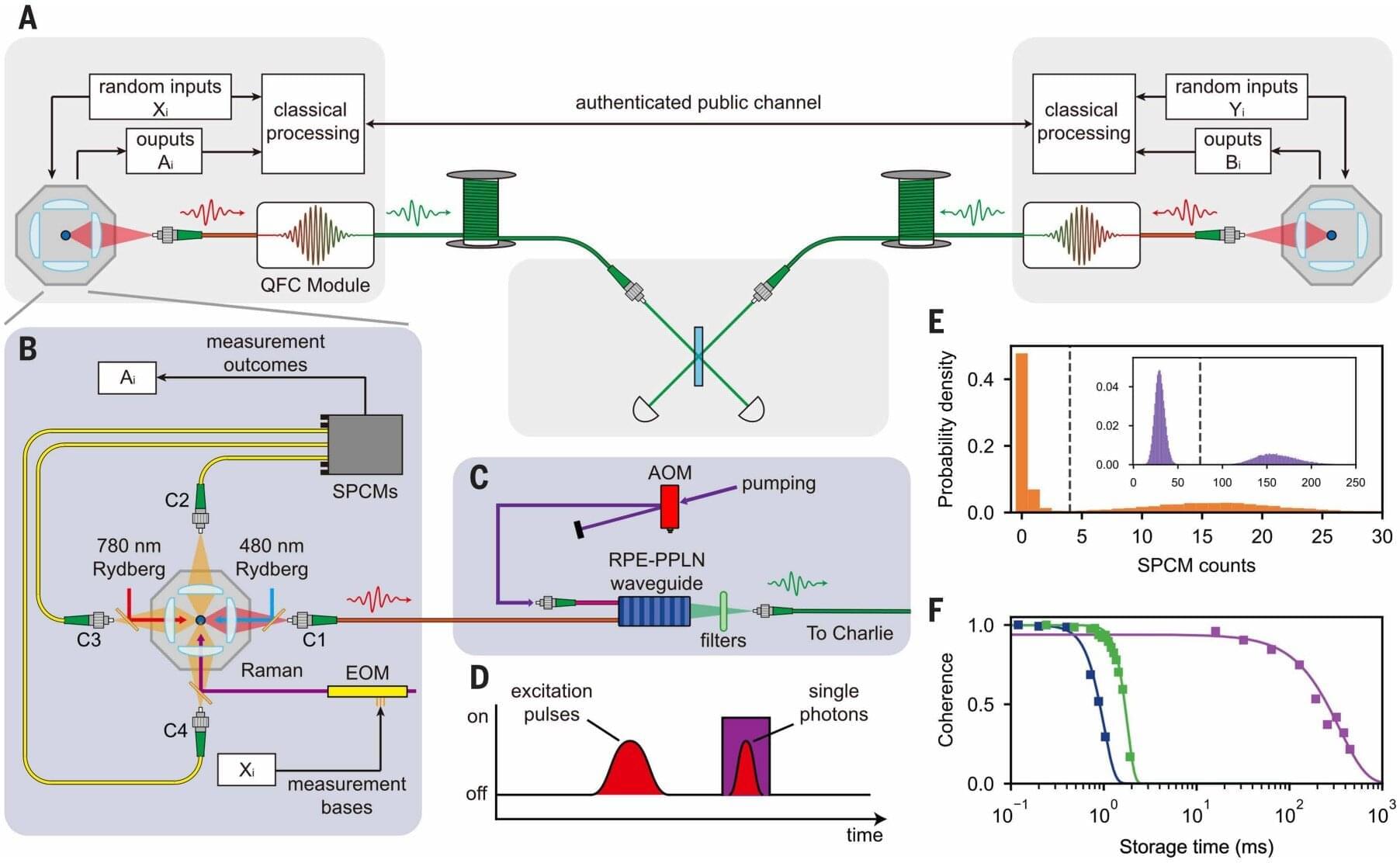
Concerns that quantum computers may start easily hacking into previously secure communications has motivated researchers to work on innovative new ways to encrypt information. One such method is quantum key distribution (QKD), a secure, quantum-based method in which eavesdropping attempts disrupt the quantum state, making unauthorized interception immediately detectable.
Previous attempts at this solution were limited by short distances and reliance on special devices, but a research team in China recently demonstrated the ability to maintain quantum encryption over longer distances. The research, published in Science, describes device-independent QKD (DI-QKD) between two single-atom nodes over up to 100 km of optical fiber.